
Pure Coordination; Two Pareto Optimal Equilibria Under Salience & Convention
Game theory analyses situations for individuals/entities using games. A game is a situation in which decisions are interdependent, creating a shared, mutual impact and is displayed on a “matrix". The combination of each “player’s” decision results in a payout, otherwise known as utility. Typically the higher the number the higher the utility.
5 Minute Read
References quoted & linked below
Pure Coordination
Pure coordination: pure meaning preferred, is when both players benefit from choosing the same two Pareto optimal equilibria. (“Coordination Game - an Overview | ScienceDirect Topics”) Or in other words, this is a coordination problem; it doesn't matter which strategy players choose- as long as their choices align, they both benefit at the most efficient outcome. There is no conflict. (Spaniel)
In this story, Riley and Sadie only win if they choose the same investment! Additionally, there’s no communication beforehand. (“Coordination Game”)
The Story of Riley & Sadie:
Say Riley and Sadie are coordinating whether to invest in the bank or to invest in the stock market, but each is in a different location, unable to communicate with each other, and must make a split minute decision: what will they choose? Hint: Focal points give us a clue…
The following tables in this matrix capture satisfaction/utility, not dollars.

The Nash Equilibria
The two pure Nash equilibria (NE) are (stocks, stocks) and (bank, bank). (Attiah et al.) (Nash equilibrium meaning no player has an incentive to change one’s strategy (deviate) given the opponent’s strategy, and is thus stable) (Suzuki, How to Present a Strategic Problem into a Game)
5, 5 if location A is chosen by both. (NE)
5, 5 if location B is chosen by both. (NE)
0, 0 if location A,B or B,A is chosen.
This game abstracts from actual return differences! The players are penalised only when there is a mismatch issue. So, what matters is only that Riley and Sadie choose the same option; coordinating gives them 5, whilst any mismatch gives them 0.
The Numbers
No Communication
For a basic, pure coordination article, we will stick with no communication, but you can extend with cheap talk. (Wikipedia Contributors)
Thus, when communication is absent, focal points are relied upon. These focal points arise from common clues such as salience and social conventions.
The following is per (Suzuki, Common Clues).
In this game, there is no dominant strategy. Instead, we can find the Nash Equilibrium with focal points, which the players rely on to make a decision that is mutually beneficial.
Salience: a strategy is said to be salient if it stands out in the decision making process due to clarity, ease of understanding, or common knowledge.
Convention: A behaviour or strategy established through repeated interaction and social norms. (Suzuki)
Payoff dominance (highest payout) and risk dominance (least risky) also exist, but are not applicable to this game.
So, for example, salience: investing in the stock market is complicated, and there’s lots of risk involved. The strategy “stock” would not be salient. On the other hand, depositing your money in a bank is easy and risk free (ticks all three boxes: clarity, ease of understanding and common knowledge!) (Author’s opinion)
Convention: the convention for Riley or Sadie is subjective: maybe Sadie’s family invests in the stock market quite frequently, so “stock” would be chosen? Or perhaps Riley wants short term gains, so goes to the bank- something that may be a social norm in his world.
Reliance On Focal Points For Finding NE
Battles of Sexes VS Pure Coordination
Unlike battle of the sexes where they want to be together, but want to see a different form of entertainment, in pure coordination they only care about being together!
(More) Real World Uses of Pure Coordination
Pure coordination is not about conflict, but about which mutually beneficial pattern is chosen. It can be applied to many real world scenarios, for example, marriage!
Example 1
Credit to my cousin for this example of pure coordination:

Both receive 5 if they both say yes or no to marriage.
However, if one says yes, whilst the other says no, they both receive 0.
Example 2
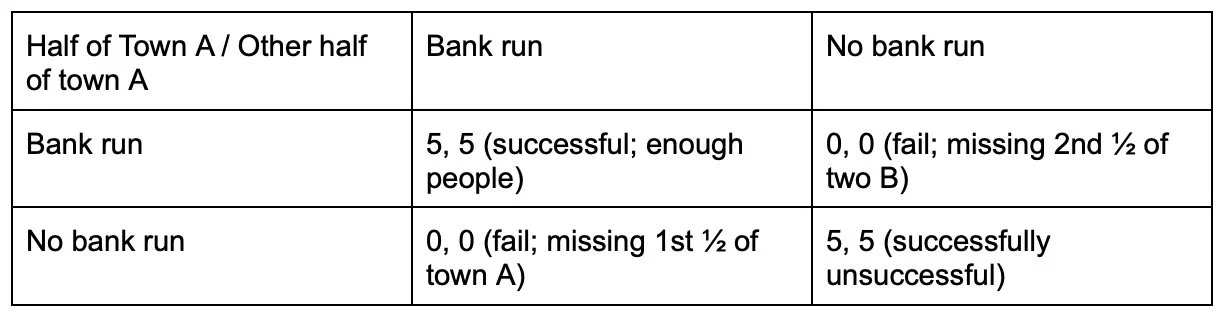
Both halves receive 5 if coordination is successful.
Both halves receive 0 if coordination is unsuccessful (not enough people for a bank run).
Pure coordination isn’t about conflict, it’s about coordination: coordinating to make a decision that is the Pareto optimal and also mutually beneficial. Two Nash equilibrium’s exist. In this article, no communication exists prior to decision making, leaving salience and convention to be the decider of the Nash equilibrium. Pure coordination can be applied to a situation where everyone’s incentives align, with correct coordination being the main barrier to the optimal outcome.
Summary
A Nash equilibrium is a stable outcome, where no player has an incentive to deviate. In pure coordination, a game with two players with two options, there are two Nash equilibriums (equilibria)- two options that are each equally the highest yielding, and there’s no incentive for a player to deviate from. So what is the barrier to reaching either equilibrium? Coordination! Each player needs to have their decisions aligned with one another. No communication is possible, thus to work out which option each player will play, one must be aware of salience (ease of understanding) and convention (social norms) which play a role in each player's decision.