
Stag Hunt EXplained:
Payoff Dominance vs Risk Dominance
Game theory analyses situations for individuals/entities using games. A game is a situation in which decisions are interdependent, creating a shared, mutual impact and is displayed on a “matrix". The combination of each “player’s” decision results in a payout, otherwise known as utility. Typically the higher the number the higher the utility.
4 Minute Read
The main thing about stag hunt is there are two Nash Equilibria: cooperation is payoff dominant (highest payout) whilst non-cooperation is risk dominant (least risky). The problem is coordination. However, when trust is weak, the players choose the risk dominant strategy, a pattern linked to risk aversion, loss aversion and the need for trust.
Stag Hunt

The numbers:
(5, 5) both choose to hunt a stag (a big meal)- a difficult task.
(2, 0) or (0, 2) hunting a stag alone is difficult, the chances a minimal, leaving one with nothing (0) and the other with a rabbit (2).
(2, 2) both choose to hunt a rabbit.
There are two nash equilibria here:
<stag, stag> cooperative equilibrium, a payoff dominant strategy
<rabbit, rabbit> non-cooperative equilibrium, a risk dominant strategy
The first Nash Equilibrium in this matrix is dependent on cooperation. <stag,stag>; (5,5): where through risk taking and luck, provides the highest reward, both receiving 5 each. This is called a payoff-dominant strategy, because it results in the greatest reward just when both individuals cooperate. (“The Stag Hunt (Game Theory) - IMotions”)
However, I emphasise it is risky, as if, for example, Adam chooses stag but Beth chooses Rabbit, Adam ends with 0 and Beth with 2.
Unsurprisingly, in this game, the players are reluctant to choose stag, and go with rabbit, because usually people hate ambiguity: they are risk averse and prefer certainty over uncertainty.
Thus, the second Nash equilibrium is a non-cooperative equilibrium. <rabbit, rabbit>; (2,2): is safer: there is a guaranteed reward of 2 even without cooperation. This is called a risk dominant strategy. (“The Stag Hunt (Game Theory) - IMotions”)
Pareto is a measure of efficiency. Something that is pareto optimal is efficient, something that is not Pareto optimal is inefficient. The <rabbit,rabbit> selection is not Pareto optimal as the players’ payoffs can all be increased. (Mikhael Shor)
Pareto Optimal
Coordination Problem
This is a coordination problem, “where the desirable coordination outcome is clear, but the coordination is risky.” (Suzuki)
Stag Hunt highlights fundamental aspects of human psychology: risk aversion, loss aversion and the need for trust.
In this matrix, it’s 5 or nothing vs 2. It’s very likely an individual would be risk averse here, and would therefore only take the stag option if the risk premium is high enough to them. This is the “price tag” of certainty. (Blunck) Going with rabbit is understandable. Furthermore, there is loss aversion: losing, so receiving 0 is felt more greatly than the benefit of winning, 5 or 2. Loss aversion explains why individuals go to great lengths to avoid loss. (Blunck) Lastly, even with risk premiums, this game shows human’s need for trust, and assurance. Without mutual trust, risk aversion and loss aversion trap us in rabbit. (“The Stag Hunt (Game Theory) - IMotions”)
What Stag Hunt Highlights
Real World Examples Of Stag Hunt
All examples are from this website. (“The Stag Hunt (Game Theory) - IMotions”)
Example 1
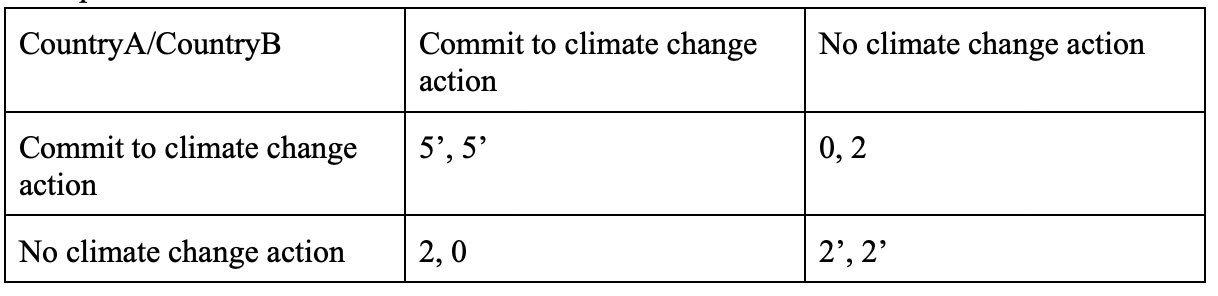
A country can commit to climate change action: cleaner air, stabilised weather patterns, and a more sustainable future, however the effort required to do so is immense.
There’s always the risk one country will do it, and others won't, leaving those who made the effort feeling shortchanged.
Or another way of thinking about it, is when justifying new actions surrounding climate change: if you look at short term costs vs long term gains, it is challenging.
Example 2

(5, 5) With climate change action, there are long term gains for both countries.
(3, 0) or (0, 3) There’s also short term costs, so if the other country doesn’t choose to take action, they earn 0, while the other earns 3 through free riding.
(2, 2) Both parties face small gains short term.

Example 3
(A, A) In this matrix, both of you working together yields a score of A each.
(D, B) or (B, D): one decides to do the work on the group project (but the group project fails) resulting in a low mark, and the other decides to do the work alone and scores a high mark.
(C, C) both choose to work alone, resulting in a moderate grade for both.
Everyone benefits if they cooperate, but there's a risk that one will defect, giving you a worse grade (B). In the end, everyone defects and ends with a lower grade.
The main thing about the prisoner's dilemma is that it’s depressing: both would benefit more greatly if they cooperated, but defection dominates. The prisoner’s dilemma is a conflict between individual rationality vs collective rationality.
The main thing about stag hunt is there is no dominant strategy: like I said earlier, cooperation is payoff dominant, and non-cooperation is risk dominant. The problem is coordination: it’s risky. It requires mutual cooperation.
Stag Hunt vs Prisoner’s Dilemma
References
Blunck, Antonia. “Risk Aversion – Everything You Need to Know.” InsideBE, 30 June 2022, insidebe.com/articles/risk-aversion/.
Shor, Mike. “Efficiency - Game Theory .net.” Gametheory.net, 2026, www.gametheory.net/dictionary/Efficiency.html. Accessed 5 Feb. 2026.
Shor, Mikhael. “Pareto Optimal - Game Theory .net.” Www.gametheory.net, www.gametheory.net/dictionary/ParetoOptimal.html.
---. “Stag Hunt - Game Theory .net.” Www.gametheory.net, www.gametheory.net/dictionary/Games/StagHunt.html.
“The Stag Hunt (Game Theory) - IMotions.” IMotions, 4 June 2024, imotions.com/blog/learning/research-fundamentals/the-stag-hunt-game-theory/?srsltid=AfmBOopu0cqgZti1HY5yLhQ5yVCYzAtuuoJapPhxYnFd8edg9PaMUzjZ. Accessed 5 Feb. 2026.
Visit profile. “Prisoners Dilemma or Stag Hunt.” Blogspot.com, 4 Jan. 2013, econbeh.blogspot.com/2013/01/prisoners-dilemma-or-stag-hunt.html. Accessed 5 Feb. 2026.