
Monopolies Explained:
The Art of A Quiet Creation
Rundown
Oikonomikos
Market Control
Why Markets Have Only One Seller
Price & Quantity Determination
Impact On Welfare
Price Discrimination
Public Policies
- Competition Laws
- Regulating Natural Monopolies
- Public Ownership
- LimitationsConclusion
“The art of a quiet creation” is a gesture to John Hicks who wrote (in a disapproving way) “the best of all monopoly profits is a quiet life.” (Lumen Learning B)
Liam Scotchmer
- A monopoly is a type of market structure in which there is a sole seller, limited substitutes for consumers, high barriers to entry for competitors, and the firm is a price maker.
- Competitors are incapable of entering due to high barriers to entry.
- Monopolies choose the quantity of output where marginal cost equals marginal revenue, and the price is consistent with this quantity.
- Monopolies do not supply enough output to be allocatively efficient, whereby quantity is produced where the value to buyers is greater than the cost to the monopolist. This creates a deadweight loss, a loss of total surplus.
- Price discrimination can be utilised by monopolies due to their market power
- Policies against monopolies include competition laws, direct regulation of monopolies, public ownership of monopolies (or doing nothing).
Rundown
“The art of managing a household” is the meaning behind oikonomikos, the term economics is derived from. Casually, (maybe in a household), we ask whether an activity is economical, or in other words, “Is this carefully managing my money?” This is efficiency! Efficiency is allocating the optimal amount of goods, that maximises value and minimises waste. (Barnier) Why does efficiency matter? Because everything is scarce, such as money, and without careful consideration of resource use, there is loss of utility.
The Art of Managing a Household
“Scarcity underpins the need for economic efficiency, as limited resources require careful distribution to enhance welfare without waste. (Barnier)
With this in mind, it’s important to ask when we inefficiently allocate the use of goods. This is called a market failure, and examples include externalities, information failure, sometimes public goods and market control. (Investopedia)
Market control: A firm who has market control holds significant market share in an industry, giving it influence over price and quantity sold of the goods or services. (Cambridge Dictionary)
Even though there are few pure monopolies in existence, we face monopolies close to it everyday: Google, Microsoft, Standard & Poors, Australia Post, Sydney Water, electricity or garbage collection firms and new drugs produced by pharmaceutical firms. (Gans et al.)
A firm is a monopoly if, per Gans et al. (2021):
1. It is the sole seller of its product in a market
2. The product has no close substitutes
3. Other firms cannot enter the market due to high barriers to entry
4. The firm has influence over prices (they are a price maker)
Market Control
There should be an influx of entrants into a market making high profits, but why is there only one seller? The reason is because of high barriers to entry.
As explained by Lumen Learning (n.d.), there are several barriers to entry, for simplicity we will use two examples to classify monopolies into two broad categories: legal monopolies and natural monopolies. (Read more examples here).
Natural monopolies arise when a firm has substantially lower production costs than those of many smaller firms. (Gans et. al) In other words, the average cost curve is always declining.
Legal monopolies form as a result of intellectual property creation. (Lumen Learning)
An example of a natural monopoly: common in utilities, a single firm can produce a product cheaper than many firms. It’s economies of scale leading to a natural monopoly. (Gans et. al) In other words, average total cost is always decreasing!
An example of a legal monopoly: Patent laws are considered to give pharmaceutical companies a monopoly over the sale of its goods for the period of years the patent lasts, and some, per Gans et al. (2021). Without any competition, this allows patent holders to charge higher prices and at an output that causes a deadweight loss. However, as a result of profit making, innovation is encouraged, so legal monopolies can be intentional and beneficial. “The idea [of patent laws] is to provide limited monopoly power so that innovative firms can recoup their investment in R&D, but then to allow other firms to produce the product more cheaply once the patent expires.” (Greenlaw and Shapiro)
Why Markets Have Only One Seller
How A Firm Determines the Quantity to Produce and Price to Charge
A monopoly would like to charge the highest price possible and produce the highest amount possible, but the downward sloping market demand curve, which says a higher price will result in a lower quantity demanded, makes that impossible.
PROFIT MAXIMISATION
Thus, subject to the demand curve, the firm can charge any price it wants, and produce as much quantity as it wants as no competition exists, so what price and quantity will it choose?
Firstly, firms need to calculate their entire total revenue and total cost curves, but more reliable is finding marginal revenue (MR) and marginal cost (MC). (Greenlaw and Shapiro) MR and MC tell a firm whether producing one more unit of output increases or decreases profit, called profit maximisation. (“Profit Maximization for a Monopoly | Microeconomics”)
Profit maximisation rule: marginal revenue equals marginal cost.
Example:
Marginal costs are greater than marginal revenue -> decrease output.
Marginal revenues are greater than marginal costs -> increase output.
This occurs until MR = MC.
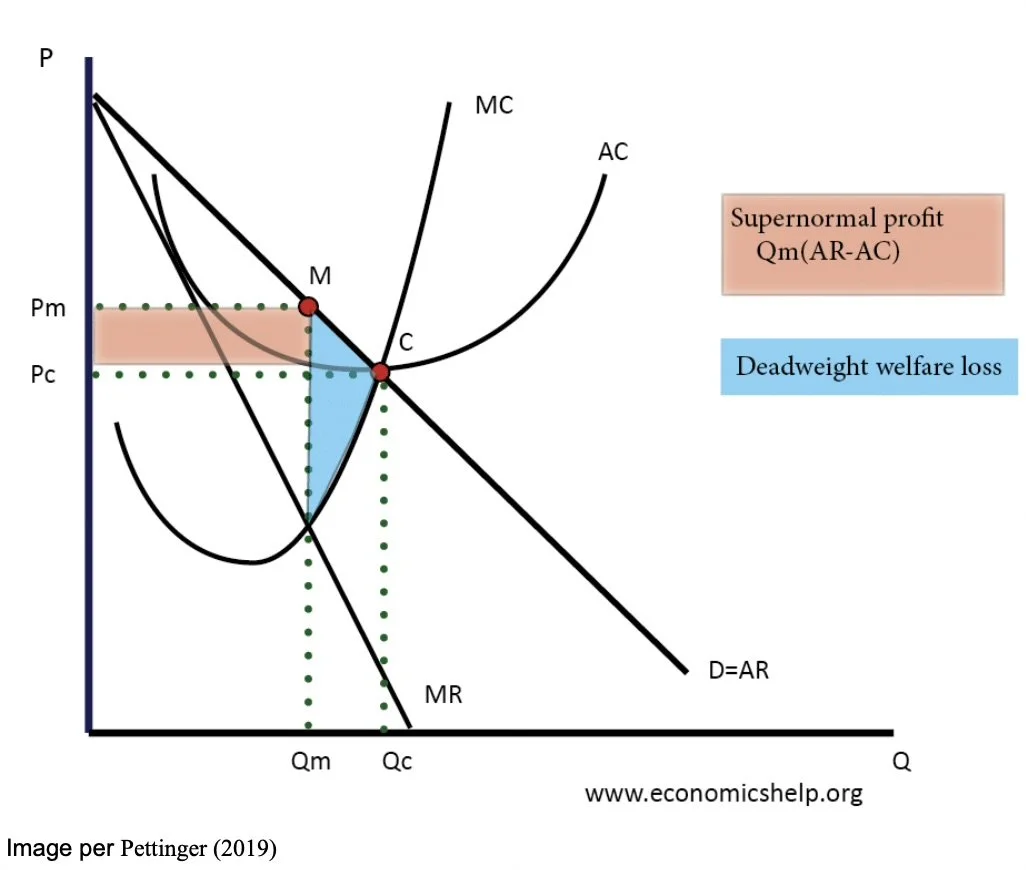
FINDING QUANTITY & PRICE ON A GRAPH
1. The firm produces at Qm where marginal cost and marginal revenue intersect on the graph above (following the profit maximisation rule).
2. The price consistent with quantity Qm is Pm - the price the monopoly sets its goods/services at.*
- A “supernormal profit” is made: (Pm - AC) x Q
*Remember, the demand curve “shows the maximum price a firm can charge to sell any quantity of output.” Thus, the price chosen is at the maximum point the firm can charge at quantity Qm. (“Profit Maximization for a Monopoly | Microeconomics”) This price is far above the intersection of marginal revenue and marginal cost.
In the long run, any profit in a competitive market would be eroded, but because of high barriers to entry in a monopoly market, no new firms can enter. Consequently, profit is made year after year. (Greenlaw and Shapiro)
Therefore, P > MR = MC for a monopoly, and P = MR = MC for a competitive firm.
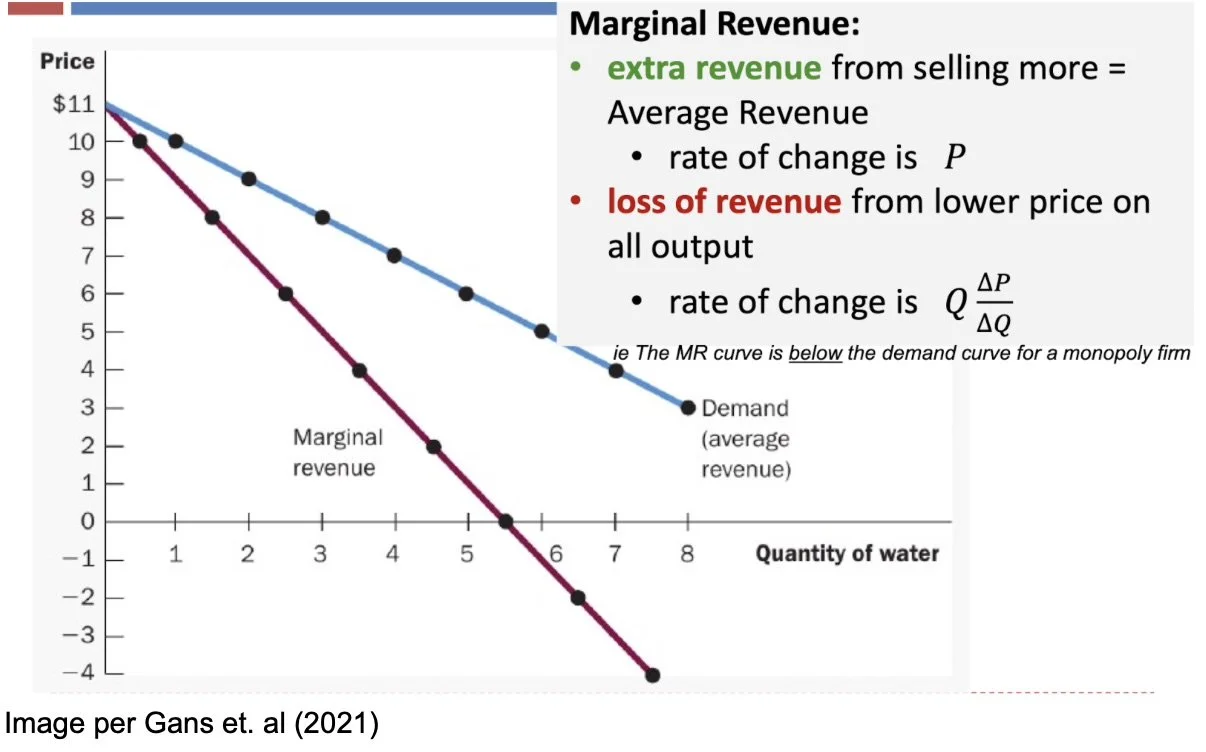
Important: Marginal Revenue < Price & The Law of Demand
In a monopoly, the marginal revenue curve for a firm is less than the market price curve.
Marginal revenue is decreasing for every unit sold! This is because, to sell additional output, the firm must reduce the price for every good, including the last units sold.
And remember, this follows the law of demand - there’s an inverse relationship between price and quantity demanded. (Comstock) Therefore, for a monopoly, marginal revenue is less than price = average revenue.
In other words:
- The market price is always equal to the average revenue curve which has a rate of change simply equal to P (or avg revenue = TR/Q)
- The marginal revenue curve has a rate of change equal to change in total revenue / change in quantity. (We calculate marginal revenue by taking the change in total revenue when output increases by one unit)
Per Greenlaw and Shapiro (2017), many people find fault with monopolies for charging too high prices, but what economists oppose is that monopolies do not supply enough output to be allocatively efficient.
Consider a perfectly competitive market, where price = marginal revenue = marginal cost. Firms are producing an efficient output, called allocative efficiency - the marginal benefit to society of one more unit just equals marginal cost. (Greenlaw and Shapiro) This benefit, known as surplus, can be seen below separated as consumer and producer surplus.
Impact on Welfare
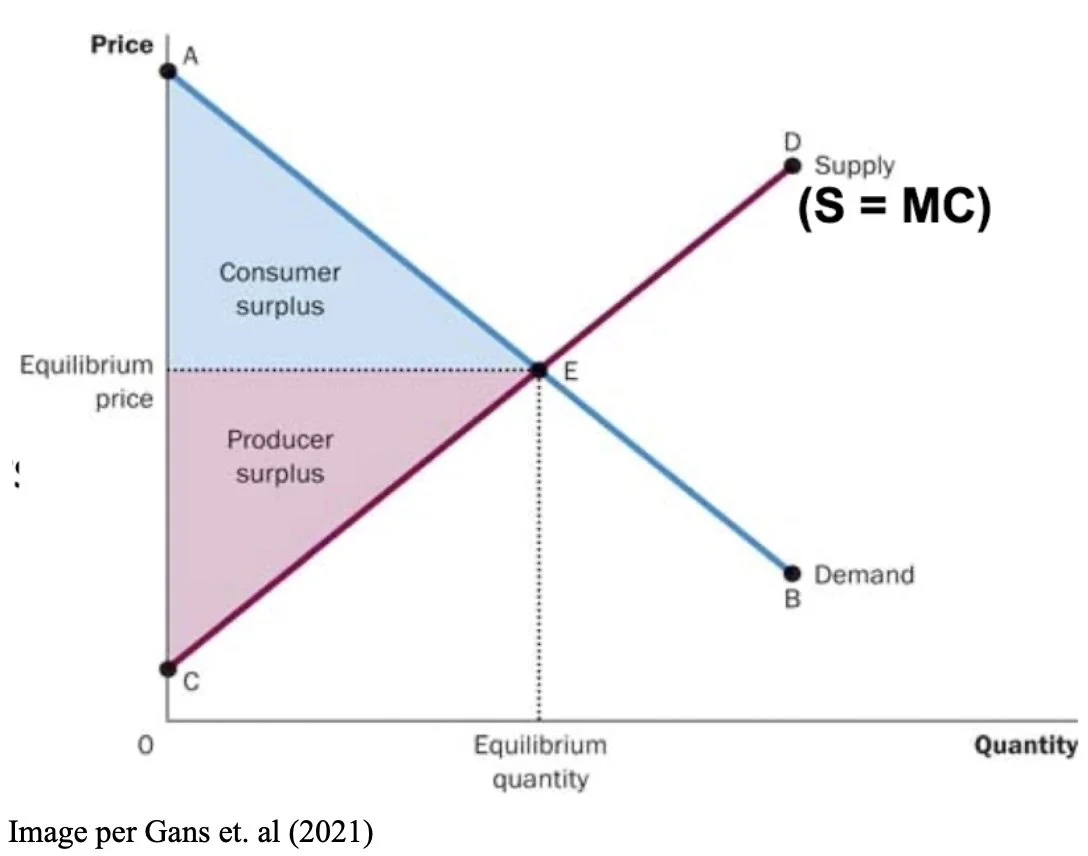
However, in a monopoly, P > MC, this is not allocatively efficient. The value to buyers is greater than the cost to the monopolist, as pictured below.
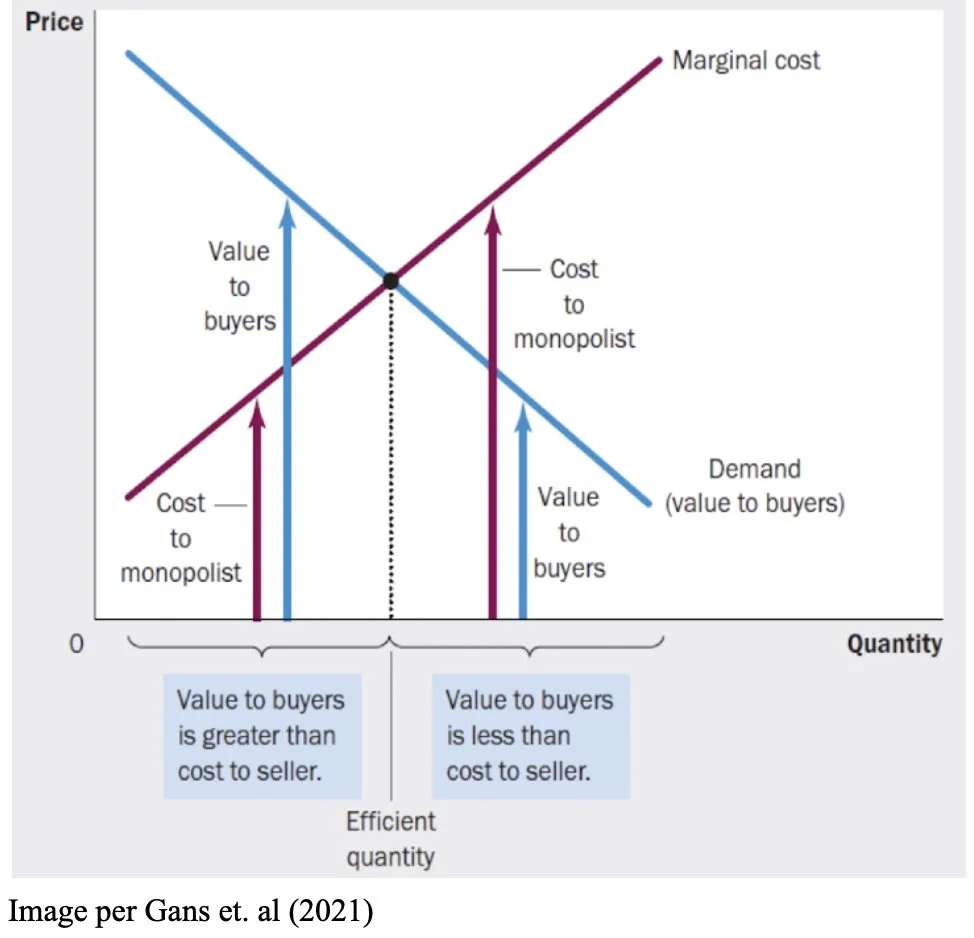
If the price or value to buyers is greater than marginal cost, more should be produced as there are unreaped benefits to society. So why doesn’t a monopoly produce more? Because, to profit maximise, MC = MR. However, for a monopoly, MR = MC is not an efficient quantity. It is at a quantity where the value to buyers is greater than the cost to sellers.
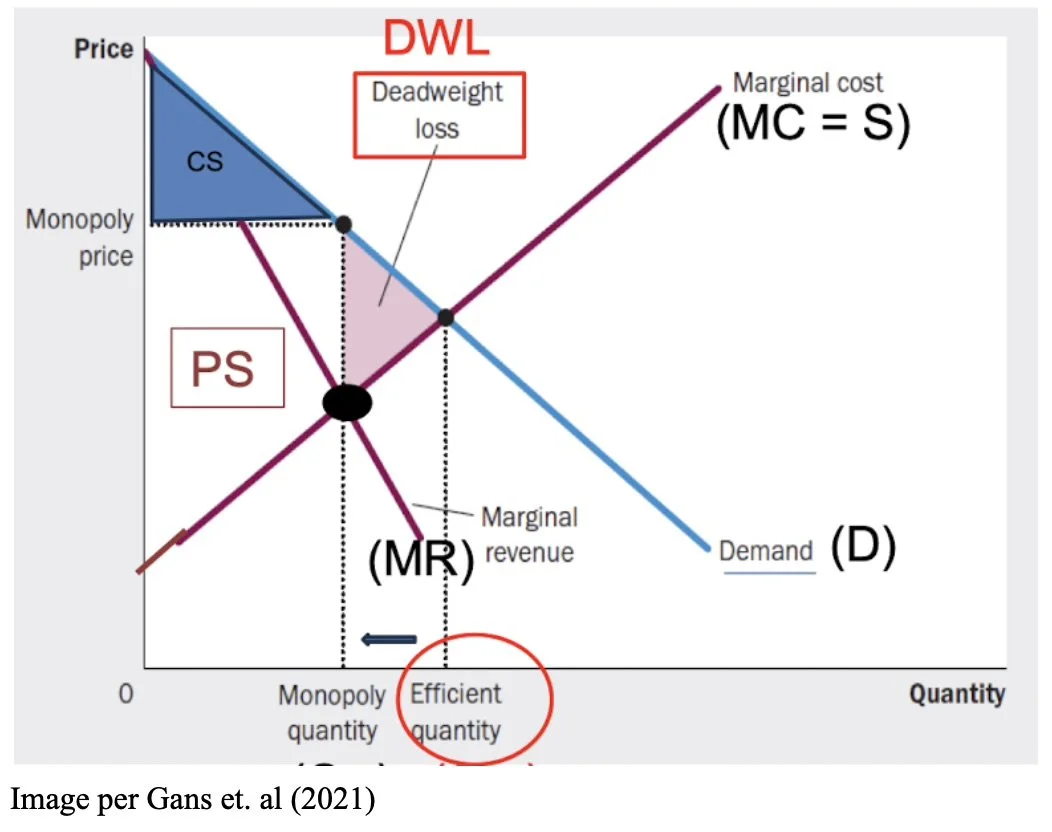
A deadweight loss is created as consumer welfare is lost as prices are higher, and quantity sold is lower, meaning some consumers are priced out of the market. The loss in consumer surplus is greater than the gain in producer surplus, and as a consequence, there’s a net loss of welfare measured by total surplus. (“Monopoly Power and Economic Welfare”)
There may be further inefficiencies created by rent seeking behaviour. As explained by Majaski (2021), rent seeking is achieving wealth “without contributing to society’s overall productivity or wellbeing.” The term “rent seeking” may sound off, but it relates to economic rent, which means “receiving a payment that exceeds the cost involved in the associated resource.” An example per Majaski (2021) includes firms hiring lobbyists to influence new regulation with skewed incentives (i.e. for government subsidies or regulations to limit competition). The firm in turn doesn't add any productivity, and instead puts capital at risk, and limits competition more though higher barriers to entry.
A Step Back
As Greenlaw and Shapiro (2017) note, there are opposing incentives here. On one hand, companies are incentivised to innovate, and create new intellectual property, however, once the barriers to entry are in place, “monopolies may bank their profits and slack off on trying to please their customers.” John Hicks, who was awarded the Nobel Prize for economics in 1972, wrote in 1935: “the best of all monopoly profits is a quiet life.”
Real World Example:
The following is written per Pearl (2023); Pharma Companies: A Conglomerate of Monopolies
There is a parallel structure between all healthcare firms in America: as market share expands, firms become complacent, and with that, innovation withers away, “and Americans pay the price, both with their wallets and their health.” Per ICER, 70% of drug price increases by pharmaceuticals were “unsupported by clinical evidence” and 9 in 10 major drug companies spend less on R&D than on marketing/sales.Pharmaceuticals stand out! They utilise a great deal of powerful tactics to keep their market share.
And prices? Large market share in an industry doesn’t mean price hikes can be made, however it’s a different matter when the consumer base is price inelastic. Drug prices are rising, drug innovation is lagging.
Price discrimination can be utilised by monopolies due to their high market power.
Price discrimination is charging different prices to different consumers for the same product to maximise revenue for sellers by understanding consumers' willingness to pay. It is successful dependent upon the elasticities of consumers: higher prices for inelastic consumers, lower prices for elastic consumers. (Twin) Price discrimination is useful for monopolies if the profit they earn from separating the market is greater than what they could have earned if the market was combined. (Twin) Per Gans et. al (2021) the surplus is captured only by the firm, however in total, society's welfare is increased!
Important to note: markets in which consumers are charged different amounts must be kept separate (by time, physical distance, or nature of use) otherwise a consumer could buy low, and sell high.
The Three types of Price Discrimination:
Per Twin (2024)
First degree price discrimination: when a company charges the maximum price per unit consumed (eg.: auctions or client service companies) or in other words, it equals exactly the consumers willingness to pay.
Second degree price discrimination: when a company charges a different price for different quantities consumed (eg.: bulk discounts).
Third degree price discrimination: when a company charges a different price to a different group of consumers (eg.: students/adults/children/retiree).
Price Discrimination
Per Greenlaw and Shapiro (2017), in perfect competition, firms are driven to lower prices, provide better quality, innovate, and consumers are given more choice.
However, if your goal was to attain large profits, would you rather own a salon with countless competitors or a few firms?
Rarely are markets perfectly competitive! Firms create high barriers to entry to front slim profit margins - as a natural monopoly (efficiency advantages) or legal monopoly (patents) to attain large market power.
Policymakers must decide how much to intervene to manage the costs and benefits of these market structures - perfect competition or a monopoly.
Per Gans et. al (2021) monopolies produce less than socially optimal, so policymakers must intervene. They can using four methods: laws, regulating behaviour,
1) Making Monopolised Industries More Competitive
Competition laws, a group of legislation, includes the Competition and Consumer Act 2010, that “bans business behaviours that damage competition.” Behaviours that are illegal include cartel activity, imposing minimum resale prices, cooperation among businesses (rather than businesses making independent decisions), misuse of market power, and exclusive dealing. (ACCC)
Per the ACCC (2023), these behaviours cheat consumers and businesses by hindering the competitive process in a market, increasing prices for consumers, and creating a deadweight loss.
However, the ACCC grants exemptions for businesses who intend to conduct activity that will or may breach competition law, with different exemption processes (i.e. authorisation, notification, class exemptions, and more). The exemption is only granted “if the conduct doesn’t substantially lessen competition or has a net public benefit.” (ACCC C)
Public Policies
Example of Competition Exemption; COVID 19 Pandemic
The following is written per ACCC D (2021); Competition exemptions in the time of COVID-19
The ACCC permitted essential industries to work together (which typically is illegal under competition law) during the Covid 19 pandemic. That covered: health, supplies, everyday needs, money, and flow on impacts from the pandemic. The ACCC believed authorising this normally anti-competitive behaviour would assist firms in meeting demand from Australians.
“Broadly, the ACCC may grant an authorisation when it is satisfied that the public benefit from conduct outweighs any public detriment.” (ACCC D)
2) Regulating (Natural) Monopolist Behaviour
Per Gans et. al (2021), regulating the behaviour of monopolists is usually common for natural monopolies.
Natural monopolies are those with production costs substantially lower than what more firms could provide, in other words, they have a declining average cost curve. Per Lumen Learning C (n.d.), natural monopolies are the closest to true monopolies. Examples include utilities like water companies, or electrical services.
Natural monopolies will price at the profit maximisation point; not socially optimal. The government can regulate prices, i.e. lower the market price, however too low of a price and the firm will make a loss. Regulating natural monopolies requires careful computation from the government of individual firms' cost formation.
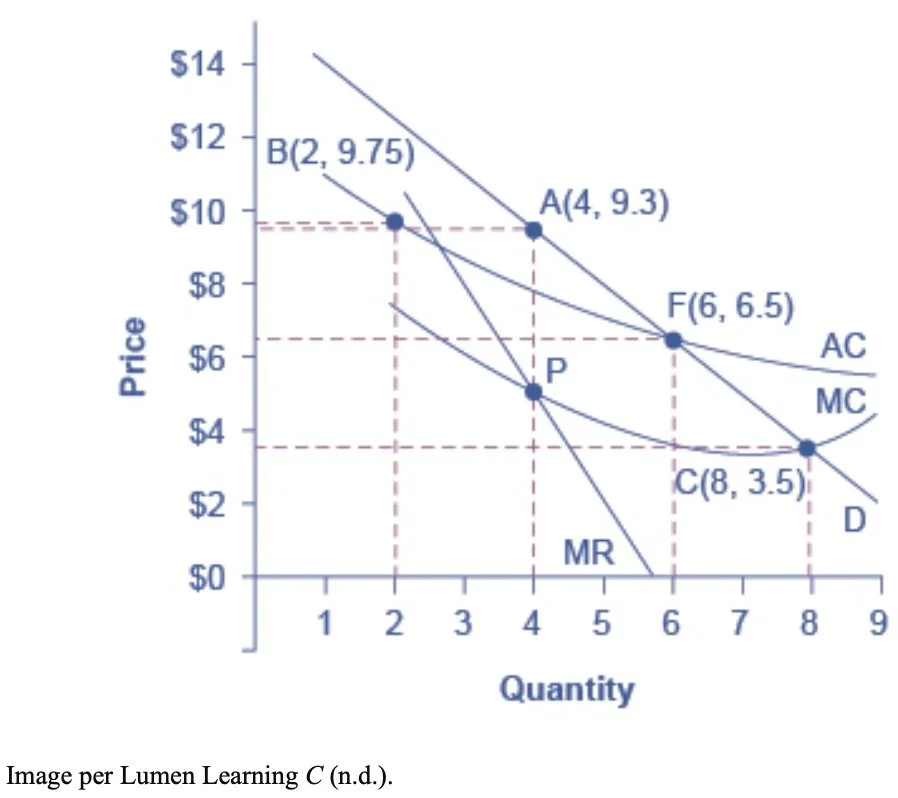
Important: Take note of where marginal revenue (MR), marginal cost (MC), and the demand (D) curve are. Also note how average cost (AC) is declining, with marginal cost less than average cost. (MC < AC signals AC will always be declining; MC is lowering the average!)
Point A: Per Lumen Learning C (n.d.) a single monopolist would produce at a quantity of 4, where marginal cost equals marginal revenue. The price would be 9.3 at point A.
Point B: If the government were to split this company in half, then each half would produce at a quantity of 2, and price of 9.75- at point B, higher than what one firm could achieve. (Lumen Learning C)
Point C: The government could regulate this market and have the firms produce at a quantity of 8, and price of 3.5, however this is below the average cost curve, and the firm would suffer losses. The government could potentially do this with a subsidy, per Gans et. al (2021), so essentially pick up the losses but paying for subsidies requires taxation, which itself generates deadweight losses.
Point F: Alternatively, the government could set the price and quantity where average cost equals price. On the graph, this is at a quantity of 6, and price of 6.5, at point F, whereby price equals average cost, so zero economic profit is made, but no losses are realised. (Lumen Learning C) As noted by Gans et al (2021), this does create a deadweight loss as the quantity produced does not reflect the marginal cost of producing the good.
3) Public Ownership of Monopolies
A private energy company would set its price at the profit maximising point, a high price to pay for consumers - therefore, per Gans. et al (2021), another alternative is having the government run the monopoly, called public ownership or a government owned monopoly.
An example includes Australia Post's ownership by the Australian government, called a natural monopoly.
Public Ownership Vs Privatisation
There are many aspects one can focus on in the debate of whether privatisation vs public ownership performs better; per Gans. et al (2021), who looked at costs of production, said
the owners of a privatised monopoly always aim to reduce costs. This is to reap from the benefit of higher profits, whereas managers of government owned monopolies are not as inclined to do so. Thus, when a government owned monopoly does a bad job, it is the taxpayers and customers who pay, “whose only recourse is the political system.”
From the World Inequality Database (WID.WORLD), the focus was what the monopoly was:
From key findings of Ewan McGaughey’s paper, “public ownership performs better when property is ‘non-accessible’ i.e. if an enterprise is a skill-based, natural, or network monopoly.” However, privatisation was found to be better when property is ‘accessible.’
(This checks with our analysis of a ‘non-accessible’ firms' cost curves from above).
1) Limitations of Competition Laws, Regulating Natural Monopolies & Public Ownership
Competition laws are failing in regards to merger laws compared to the rest of the world; per the ACCC (D 2021), the ACCC does not need to grant approval for mergers. In lieu, if action is needed to cease a merger, section 50 of the CCA is enacted; or more casually, it requires persuasion at the Federal Court level.
Regulating natural monopolies: Per Dimasi (2015), on “rethinking utility regulation in Australia” (i.e. regulating natural monopolies), it is a search for the “right” / efficient price, leading to "regulatory gaming since entities have strong incentives to challenge the grounds on which the “right” price is set.” Information asymmetry is the cause, and is just one example of the downsides to regulating natural monopolies.
Public Ownership: As mentioned above, per Gans. et al (2021), the privatisation of a firm leads to lower production costs, whereas government owned monopolies are less incentivised to lower their production costs.
Public Policy End
Competition laws, regulation of natural monopolies, and public ownership have disadvantages. Therefore, per Gans et. al (2021), relinquishing all policies aimed at solving the deadweight losses caused by monopolies is an option, as per George Stigler, Fortune Encyclopedia of Economics, “the degree of ‘market failure’ for the American economy is much smaller than the ‘political failure’ arising from the imperfections of economic policies found in real political systems.”
What Is A Monopoly?
Google, Microsoft, Standard & Poors, Australia Post, and Sydney Water are all examples of monopolies, whilst not pure monopolies, they come close to it; a market structure in which there is a sole seller, limited substitutes for consumers, high barriers to entry for competitors, and the firm is a price maker.
Why Are There No Entrants Into A Monopoly Market Structure?
This market structure is lucrative, yet competitors are incapable of entering due to high barriers to entry, for reasons such as the sole firm in its market being a natural monopolist (having lower production costs than what more firms could achieve), or a legal monopolist (holding intellectual property).
What Price And Quantity Does A Monopolist Choose?
Monopolies choose the quantity of output where marginal cost equals marginal revenue, and the price is consistent with this quantity.
What Is A Monopolies Impact On An Economy?
Monopolies do not supply enough output to be allocatively efficient, whereby quantity is produced where the value to buyers is greater than the cost to the monopolist. This creates a deadweight loss, a loss of total surplus.
Why Do Monopolies Employ Price Discrimination Strategies?
Price discrimination can be utilised by monopolies due to their high market power: price discrimination is charging different prices to different consumers for the same product depending on consumers' willingness to pay and is successful depending on their price elasticity of demand. When different consumers are charged different prices, markets must be kept separate through time, physical distance, or nature of use. There are three degrees of price discrimination: 1st degree (auctions), 2nd degree (quantity dependent), 3rd degree (group type dependent). Price discrimination is useful for monopolies if the profit they earn from separating the market is greater than what they could have earned if the market was combined.
What Are Examples of Public Policies Against Monopolies?
Competition laws, a group of legislation, includes the Competition and Consumer Act 2010 (in Australia) that bans business behaviours that damage competition. Regulation of Monopolies, typically with natural monopolies, is where the government regulates prices, where price equals average cost; zero economic profit is made. Public Ownership of Monopolies is where governments run the monopoly. There are limitations to these policies.
Conclusion
References
ACCC. “Competition and Anti-Competitive Behaviour.” Www.accc.gov.au, 2023, www.accc.gov.au/business/competition-and-exemptions/competition-and-anti-competitive-behaviour.
ACCC B. “Competition and Why It Matters.” Australian Competition and Consumer Commission, www.accc.gov.au/consumers/competition-and-why-it-matters.
ACCC C. “Exemptions from Competition Law.” Australian Competition and Consumer Commission, 26 Feb. 2023, www.accc.gov.au/business/competition-and-exemptions/exemptions-from-competition-law. Accessed 9 Mar. 2026.
ACCC D. “Competition Exemptions in the Time of COVID-19.” Australian Competition and Consumer Commission, 15 Apr. 2021, www.accc.gov.au/media-release/competition-exemptions-in-the-time-of-covid-19.
ACCC E. “Protecting and Promoting Competition in Australia Keynote Speech.” Www.accc.gov.au, 27 Aug. 2021, www.accc.gov.au/about-us/news/speeches/protecting-and-promoting-competition-in-australia-keynote-speech.
Barnier, Brian . “Economic Efficiency Definition.” Investopedia, 30 June 2024, www.investopedia.com/terms/e/economic_efficiency.asp.
Cambridge Dictionary. “Market Control.” @CambridgeWords, 5 Oct. 2022, dictionary.cambridge.org/dictionary/english/market-control.
Comstock, Nancy. “Law of Demand | EBSCO.” EBSCO Information Services, Inc. | Www.ebsco.com, 2023, www.ebsco.com/research-starters/economics/law-demand.
Dimasi, Joe. “RETHINKING UTILITY REGULATION in AUSTRALIA.” Monash Business Policy Forum, 2015, www.monash.edu/__data/assets/pdf_file/0005/906971/rethinking-utility-regulation-in-australia-final.pdf.
“Etymonline.” Etymonline.com, 2017, www.etymonline.com/word/economics.
“Etymonline.” Etymonline, 2026, www.etymonline.com/word/thrift. Accessed 5 Mar. 2026.
Gans, Joshua, et al. Principles of Microeconomics. South Melbourne, Victoria, Australia, Cengage Learning Australia, 2021.
Greenlaw, Steven A. , and David Shapiro. “Ch. 9 Introduction to a Monopoly - Principles of Economics 2e | OpenStax.” Openstax.org, 2017, openstax.org/books/principles-economics-2e/pages/9-introduction-to-a-monopoly.
Hayes, Adam. “What Is a Monopoly? Types, Regulations, and Impact on Markets.” Investopedia, 21 June 2024, www.investopedia.com/terms/m/monopoly.asp.
Investopedia. “Market Failure.” Investopedia, 7 Apr. 2024, www.investopedia.com/terms/m/marketfailure.asp.
Lumen Learning. “How Monopolies Form: Barriers to Entry | Microeconomics.” Courses.lumenlearning.com, courses.lumenlearning.com/wm-microeconomics/chapter/how-monopolies-form-barriers-to-entry/.
Lumen Learning B. “The Inefficiency of Monopoly | Microeconomics.” Lumenlearning.com, 2019, courses.lumenlearning.com/wm-microeconomics/chapter/the-inefficiency-of-monopoly/.
Lumen Learning C. “Regulating Natural Monopolies | Microeconomics.” Courses.lumenlearning.com, courses.lumenlearning.com/wm-microeconomics/chapter/reading-regulating-natural-monopolies/.
Majaski, Christina. “Understanding Rent Seeking and How It Works.” Investopedia, 3 Dec. 2021, www.investopedia.com/terms/r/rentseeking.asp.
McWhinney, James. “How and Why Companies Become Monopolies.” Investopedia, 31 July 2021, www.investopedia.com/articles/investing/071515/how-why-companies-become-monopolies.asp.
“Monopoly Power and Economic Welfare.” Tutor2u.net, 2018, www.tutor2u.net/economics/reference/monopoly-power-and-economic-welfare?srsltid=AfmBOooKtD7tdMzXjfjepSV09QU_38W6hfSN-w8Htuyj8uAauFLkmhO8. Accessed 6 Mar. 2026.
Pearl, Robert . “Pharma Companies: A Conglomerate of Monopolies.” Forbes, 31 Jan. 2023, www.forbes.com/sites/robertpearl/2023/01/31/pharma-companies-a-conglomerate-of-monopolies/.
Pettinger, Tejvan. “Monopoly | Economics Help.” Economicshelp.org, 28 Oct. 2019, www.economicshelp.org/microessays/markets/monopoly/.
“Profit Maximization for a Monopoly | Microeconomics.” Courses.lumenlearning.com, courses.lumenlearning.com/wm-microeconomics/chapter/profit-maximization-for-a-monopoly/.
Twin, Alexandra. “Price Discrimination.” Investopedia, 27 June 2024, www.investopedia.com/terms/p/price_discrimination.asp.
WID.WORLD. “Public Ownership Outperforms Privatisation When an Enterprise Is a Skill-Based, Natural, or Network Monopoly - WID - World Inequality Database.” WID - World Inequality Database, Sept. 2025, wid.world/news-article/public-ownership-outperforms-privatisation-when-an-enterprise-is-a-skill-based-natural-or-network-monopoly/.